
Last Updated: October 29, 2026
Quick Summary
End-to-end event production is the management of an event from the first brief to the final recording, covering creative concept, technical delivery and live execution. It means one accountable party spans both event production (staging, lighting, sound, AV, video and streaming) and event management (venue, suppliers, budgets, guest flow).
- Production stages run in four blocks: concept and pre-production, build-up, show days, and pack-down with evaluation.
- Every plan needs a named owner for each line item, a contingency for each critical path, and one source of truth for the run of show.
- Set contingency at 10-15% of the subtotal for a first-time venue and 5-10% for a repeat venue.
- Cost per attendee falls as audience size rises because fixed technical and labour costs spread across more people.
- Track recording views, clip performance and asset reuse over the 30 days after the event.
Table of Contents
- What End-to-End Event Production Actually Means
- Event Production Stages From Brief to Breakdown
- Building an Event Production Plan That Holds Up
- The Event Production Checklist Every Organiser Needs
- Live Event Production: Staging, AV and Show Calling
- Budget Drivers and Cost Decisions in Production
- Streaming, Hybrid Delivery and What Changes
- Measuring Outcomes After the Event
- Frequently Asked Questions
What End-to-End Event Production Actually Means
End-to-end event production is the management of an event from the first brief to the final recording, covering creative concept, technical delivery and live execution.
Most guides split production and management into two tidy boxes. In practice, that split is where events fail. The brief gets signed off by one party, the staging is built by another, and the stream is handed to a third who has never seen the run of show. When something slips, everyone points sideways.
The distinction matters commercially. Event production is the technical and creative build: staging, lighting, sound, audio-visual (AV), video and streaming. Event management is the logistics and stakeholder layer: venue, suppliers, budgets, guest flow. End-to-end production means one accountable party spanning both, which is why the Australian Centre for Event Management treats integration as a core competency rather than a nice-to-have.
Event Production Stages From Brief to Breakdown
Event production stages run in four blocks: concept and pre-production, build-up, show days, and pack-down with post-event evaluation. Each block ends at a decision checkpoint where budget, approvals or technical sign-off must be locked before the next begins.
The Australian Business Events Association frames this as a sequence of accountability gates, and that framing is worth borrowing. Skip a gate and you pay for it on site.
Pre-production: concept, budget and approvals
Pre-production is where the event concept, creative direction and event vision are tested against money and venue constraints. It ends when the budget is approved and the run of show is signed off. Everything after is delivery.
Build-up, show days and pack-down
Build-up covers load-in, rigging, AV integration and rehearsal. Show days are show calling and on-site execution. Pack-down is de-rig, asset recovery and post-event evaluation.
| Phase | Typical Timing | Key Output | Decision Checkpoint |
|---|---|---|---|
| Concept and pre-production | Weeks out | Brief, budget, run of show | Budget approved |
| Build-up | Days out | Rigged staging, tested AV | Technical rehearsal passed |
| Show days | Event day | Live delivery, show calling | Daily debrief |
| Pack-down and evaluation | Post-event | Recordings, ROI report | Sign-off |
Building an Event Production Plan That Holds Up
Three things belong in every plan, and most get left out:
- A named owner for every line item. Not a department. A person.
- A contingency for each critical path. Power, connectivity, and a backup encoder for anything streamed.
- A single source of truth for the run of show. Version control on that document prevents most on-site confusion.
Watch out: the most common failure is treating the production plan as a document rather than a living schedule. If it is not updated weekly in pre-production, it is already stale.
The Event Production Checklist Every Organiser Needs
An event production checklist works when it is grouped by phase and each item has an owner and a due date. A flat list of tasks is a to-do list, not a production document.
Use this as a starting framework:
- Event objectives and success measures agreed with stakeholders
- Venue selected and site inspection completed
- Creative direction and event concept signed off
- Budget approved with contingency line
- Supplier and vendor contracts executed
- Risk management and contingency planning documented
- Run of show drafted and circulated
- Technical rehearsal scheduled and completed
- Show calling roles assigned
- Recording and archive requirements confirmed
- Post-event evaluation owner appointed
Live Event Production: Staging, AV and Show Calling
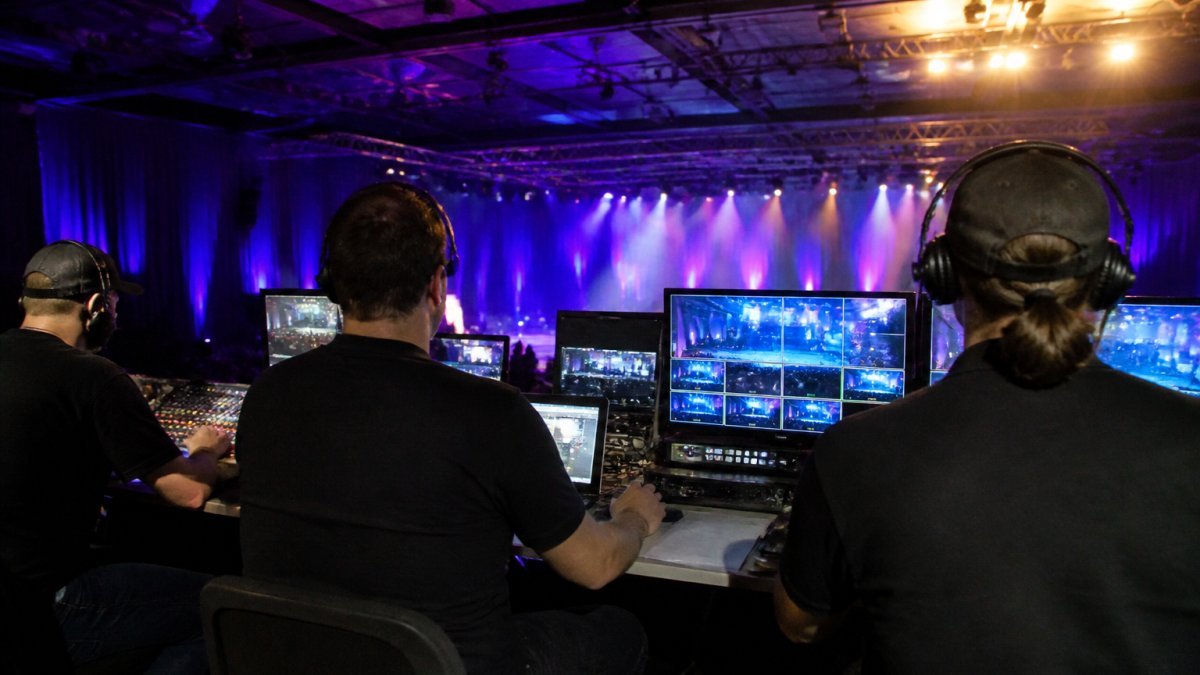
Beyond the technical precision of lighting and sound, the sensory experience of a venue is often anchored by the deliberate art of customizing event florals to harmonize with the overall production design.
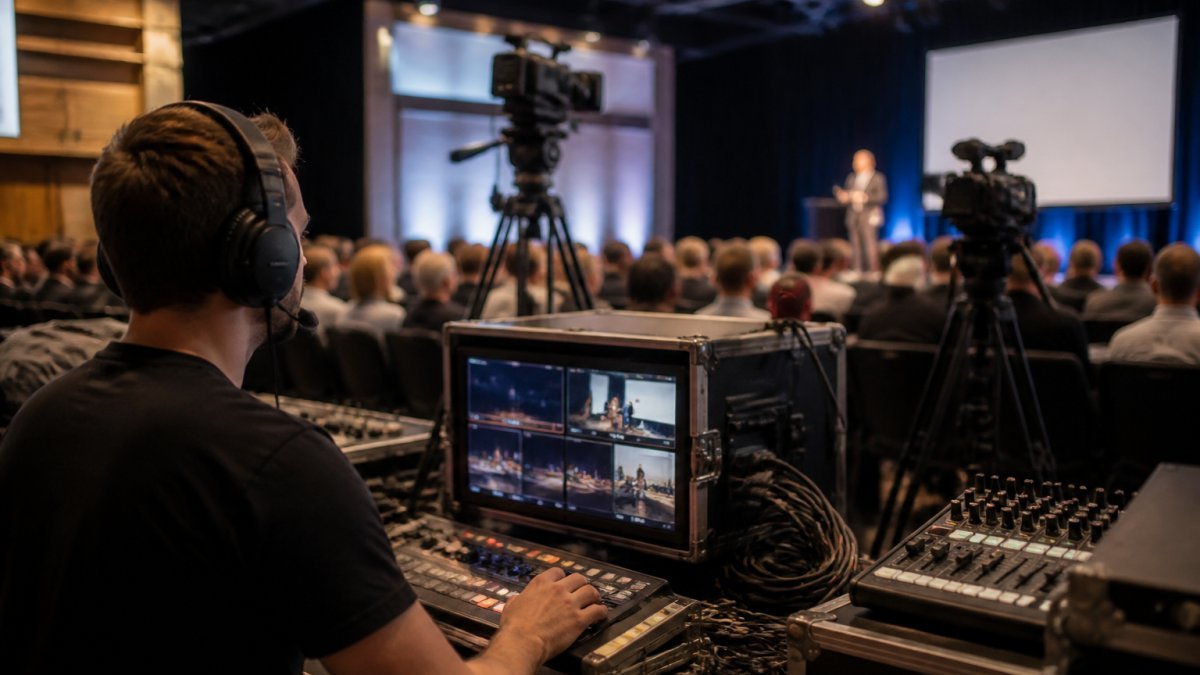
Technical production also covers AV integration, which is where staging meets signal flow. A staging build that looks right but has no plan for cable runs, sightlines or camera positions will cost you on the day. If you want a deeper look at how this is staged for broadcast, our guide to cinematic live event production covers the techniques in detail.
Budget Drivers and Cost Decisions in Production
Production budgets are driven by four things: venue, technical equipment, people, and contingency. Everything else is a rounding error by comparison. What most guides never do is break those four into line items you can actually price, so here is the structure a production budget should follow.
The five cost categories that matter
- Contingency. A genuine contingency line sits at 10-15% of the subtotal for a first-time venue and 5-10% for a repeat venue. It is not optional; it is the line that saves the event when a supplier fails or a venue throws a late constraint at you.
How scale, venue and format move the number
A common pattern is that cost per attendee falls as audience size rises, because fixed technical and labour costs spread across more people. A 100-person event in a hotel function room and a 100-person event in a heritage warehouse can differ by 30-50% on venue and rigging alone, with identical content. Hybrid adds a second cost stack: cameras, encoding, connectivity and a remote host, which typically adds a meaningful fixed increment regardless of in-room audience size.
The trade-offs worth arguing about
Pricing for streaming and production services depends on scale, dates and delivery requirements. What we will say is that the contingency line is not optional. It is the line that saves the event when a supplier fails or a venue throws a late constraint at you.
Streaming, Hybrid Delivery and What Changes
For teams building this out, our professional guide to livestreaming business events covers the delivery model, and the essential tips for hybrid conference tech setup walk through the practical setup. If you are comparing platforms, the best live streaming solutions for hybrid events lays out the trade-offs.
Measuring Outcomes After the Event
Post-event evaluation is where production earns its next budget. Measure against the event objectives set in pre-production, not against a generic dashboard.
Set objectives before you set the run of show
Every objective should be written so it can be measured after the event. A useful pattern is objective → metric → target → owner:
| Objective | Metric | Example target | Owner |
|---|---|---|---|
| Reach a defined audience | Registered versus attended | 70% attendance rate | Marketing lead |
| Deliver clean technical delivery | Cue errors, stream uptime | Zero unplanned cue misses; 99%+ uptime | Production manager |
| Generate pipeline | Qualified leads captured | Agreed number per session | Sales lead |
| Satisfy attendees | Post-event survey score | Agreed satisfaction threshold | Experience lead |
| Extend content life | Recording views in 30 days | Agreed view count | Content lead |
The four measures that do most of the work
- Content afterlife. Track recording views, clip performance and asset reuse over the 30 days after the event. That last one matters more than most organisers realise. If the recording is owned by the production partner rather than the organiser, the asset stops there.
Calculating return on investment
The Australian Communications and Media Authority publishes guidance on broadcasting and content obligations worth checking if your event is streamed publicly.
Frequently Asked Questions
What is the difference between event management and event production?
Event management covers the logistics and administration of an event. Event production covers its technical and creative delivery. End-to-end event production brings both together.
What are the stages of end-to-end event production?
Event production can be organised into stages, from planning through live execution and post-event evaluation.
What is included in an event production plan?
A production plan can set out the event’s schedule, responsibilities and requirements.
How does event production work for a live-streamed event?
A streamed event adds a streaming component to the event. Recordings belong to you.
What happens after an event has finished?
Pack-down is followed by a post-event review covering what ran to plan, what did not, and what to change next time. Production teams deliver recorded footage, show files and an asset list, and organisers review attendance, engagement and budget against the original objectives. Agree on recording ownership and delivery format before the event, so the footage is usable for training or communications without further negotiation.
Who is responsible for the technical side of an event?
Responsibility for the technical side of an event can be assigned to a designated person.
Running an event where the stream cannot afford to fail means the production partner has to own the technical delivery, not just supply equipment. Webcasting Livestream provides managed, end-to-end webcasting with fail-safe procedures, HD quality across all devices, and full recordings supplied at no extra cost, with content that stays yours. Get started with Webcasting Livestream and take the technical risk off your team’s plate.