
Last Updated: October 23, 2026
Quick Summary
A reliable webcast platform for investor relations delivers clean audio and video to every shareholder on every device, keeps a recording you own outright, and has a tested plan for when something goes wrong. We build investor broadcasts around three non-negotiables: no drop-off guarantee, fail-safe procedures, and full recording ownership.
- Ask every shortlisted provider for the failover plan in writing before you sign.
- Confirm recordings are delivered as source files with no reuse fees or hosting lock-in.
- Match the production model to your internal capacity: managed for thin IT teams, self-service for frequent small updates.
- Confirm all four security controls in writing: access, download and reuse, storage and retention, and disclosure workflow.
- Rehearse the full AGM run-through, including Q&A moderation and handover to on-demand replay.
Table of Contents
- What a Reliable Webcast Platform Must Deliver for Investor Relations
- Platform Comparison: Reliable Webcast Options for Investor Relations
- Choosing an Investor Relations Webinar Platform That Earns Trust
- What Makes a Secure Webcast Platform for Sensitive Financial Communications
- Live Streaming for Annual General Meetings: Reliability Under Scrutiny
- Webcast Recording and On-Demand Access: Who Owns the Content
- Conclusion
- Frequently Asked Questions
What a Reliable Webcast Platform Must Deliver for Investor Relations
A reliable webcast platform for investor relations is one that delivers clean audio and video to every shareholder on every device, keeps a recording you own outright, and has a tested plan for the moment something goes wrong. At Webcasting Livestream, we build investor broadcasts around three non-negotiables: no drop-off guarantee, fail-safe procedures, and full recording ownership.
Investor relations is unforgiving. An earnings call or investor update has one shot, and a frozen stream or lost audio is remembered long after the numbers are forgotten. General webinar software is designed for marketing teams running lead-generation sessions, not for boards answering questions from institutional shareholders under time pressure.
The Six Criteria That Separate Reliable Platforms From the Rest
- Uptime and failover: redundant encoders, backup network paths, and a tested switchover plan.
- Security and access control: registration gating, password protection, and closed sessions for sensitive updates.
- Recording ownership: recordings delivered to you, with no lock-in or reuse fees.
- Device-consistent HD quality: the same clean picture on desktop, tablet, and mobile.
- IR workflows: Q&A moderation, registration capture, and on-demand replay hosting.
- Live support: a technician on the broadcast, not a ticket queue.
The criterion most platforms fail is the one hardest to demo: what happens when the primary connection drops mid-sentence. Ask for the failover plan in writing before you sign.
Platform Comparison: Reliable Webcast Options for Investor Relations
Most comparison tables for investor relations webcasting are little more than vendor lists. A useful comparison evaluates each option against the criteria that actually determine whether an earnings call or annual general meeting runs cleanly: failover architecture, recording ownership, IR-specific workflows, support model, and total cost at your event scale. The table below scores the main options on those dimensions rather than on marketing claims.
Comparison Table: Criteria-Based Evaluation
| Platform | Production model | Failover evidence to request | Recording ownership | IR workflow depth | Support model | Pricing structure |
|---|---|---|---|---|---|---|
| Webcasting Livestream | Managed production | Written failover plan, rehearsal walkthrough, on-broadcast technician | Full ownership, source files delivered, no reuse fees | Registration gating, Q&A moderation, replay hosting | Dedicated technician on every broadcast | Event-scoped quote; ask for AGM total cost including recording delivery |
| Notified | Managed/self-service hybrid | Ask for redundancy architecture and switchover test results | Confirm in writing; check for hosting lock-in | IR Hub with AI-assisted workflows, earnings calendar integration | Tiered support; confirm whether a producer is included | Subscription plus event fees; request itemised quote |
| EQS Webcast | Managed production | Ask for encoder redundancy and backup network path details | Confirm delivery format and reuse terms | Audio-only or full video; disclosure distribution | Confirm response times and rehearsal support | Event-based; request quote by event type |
| GlobalMeet Webcast | Self-service with optional production | Ask for uptime commitments and incident history | Check whether recordings are downloadable or platform-locked | Registration, Q&A, analytics; less IR-specific | Ticket-based unless production add-on purchased | Subscription tiers; confirm per-viewer or per-recording charges |
How to Read the Table
Three columns deserve the most scrutiny. Failover evidence is the only proof of reliability that matters; a vendor that cannot produce a written switchover procedure or walk you through a rehearsal is asking you to accept risk you cannot quantify. Recording ownership determines your long-term cost: a platform that hosts your recording and charges for reuse or download converts a one-off event into an annuity. Pricing structure is where headline rates mislead; an event-based quote that excludes production, recording delivery, or replay hosting is not comparable to an all-in managed quote.
The Reliability Gap in Published Comparisons
None of the major published comparisons disclose uptime figures, redundancy architecture, disaster recovery arrangements, or service-level commitments in a form buyers can verify. That absence is itself the finding: reliability is the criterion vendors are least willing to put in writing. Treat any comparison that omits it as incomplete, and ask every shortlisted provider the same five questions in writing before you compare quotes.
A low headline rate often hides per-viewer, per-recording, or replay-hosting charges. Ask for the total cost of one annual general meeting including recording delivery and on-demand hosting before comparing quotes.
For a deeper look at how managed production compares with self-service platforms, see our enterprise live streaming platform requirements checklist. If you are weighing a named corporate webcast vendor against other options, our breakdown of Synergy video alternatives for corporate webcasts covers the trade-offs.
Choosing an Investor Relations Webinar Platform That Earns Trust
Trust in an investor relations webinar platform comes down to evidence, not feature lists. Ask three questions: can the provider show a failover test, will they name the support person who will be on your broadcast, and do you keep the recording without conditions? A platform that answers all three clearly is worth shortlisting.
What most buyers miss is that the platform matters less than the production model behind it. A self-service tool puts the technical risk on your stretched IT team. A managed service carries that risk for you, which is why we recommend matching the model to your internal capacity before comparing features.
- Thin IT team? Choose managed production with an on-broadcast technician.
- Frequent, small updates? A self-service platform with strong access controls may suffice.
- One flagship AGM a year? Pay for reliability and rehearsal, not volume.
What Makes a Secure Webcast Platform for Sensitive Financial Communications
Security for investor communications is not one control but four: who can watch, what they can download, where the recording is stored, and how the disclosure is distributed and retained. Most platform pages address only the first. A platform suitable for sensitive financial communications should let you confirm all four in writing before a contract is signed.
The Four Controls to Confirm in Writing
- Access control. Registration gating, password-protected sessions, and closed broadcasts for internal or board-only updates. Confirm whether registration data is exportable to your investor relations CRM and whether you can pre-approve attendees.
- Download and reuse control. Decide whether recordings and transcripts are downloadable by attendees or restricted to your team, and confirm that you receive source files rather than platform-locked copies.
- Storage and retention. Ask where recordings are hosted, for how long, and on what terms they can be retrieved after the contract ends. Retention periods should match your internal record-keeping policy and any applicable disclosure obligations.
- Disclosure and distribution workflow. Confirm how the replay, transcript, and presentation materials are published to your investor page, and whether the platform supports the timing controls your disclosure process requires.
Accessibility as a Disclosure Requirement
Accessibility is not a nice-to-have for investor communications. Materials should reach shareholders who use screen readers or require captions, so ask whether live captions, transcripts, and accessible player controls are supported as standard or as paid add-ons. Confirm caption accuracy arrangements and whether transcripts are delivered with the recording or separately. A platform that treats accessibility as an add-on is signalling that it has not built for regulated disclosure.
Questions That Separate Serious Providers
Ask each shortlisted provider: Can you show a sample disclosure workflow from live event to published replay? What is your recording retention policy, and what happens to recordings if we leave? Are live captions and transcripts included, and who is responsible for accuracy?
Accessibility matters too. Our guide to high quality event webcasting solutions sets out what to check for secure, accessible financial broadcasts.

Live Streaming for Annual General Meetings: Reliability Under Scrutiny
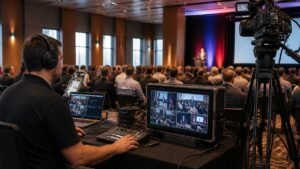
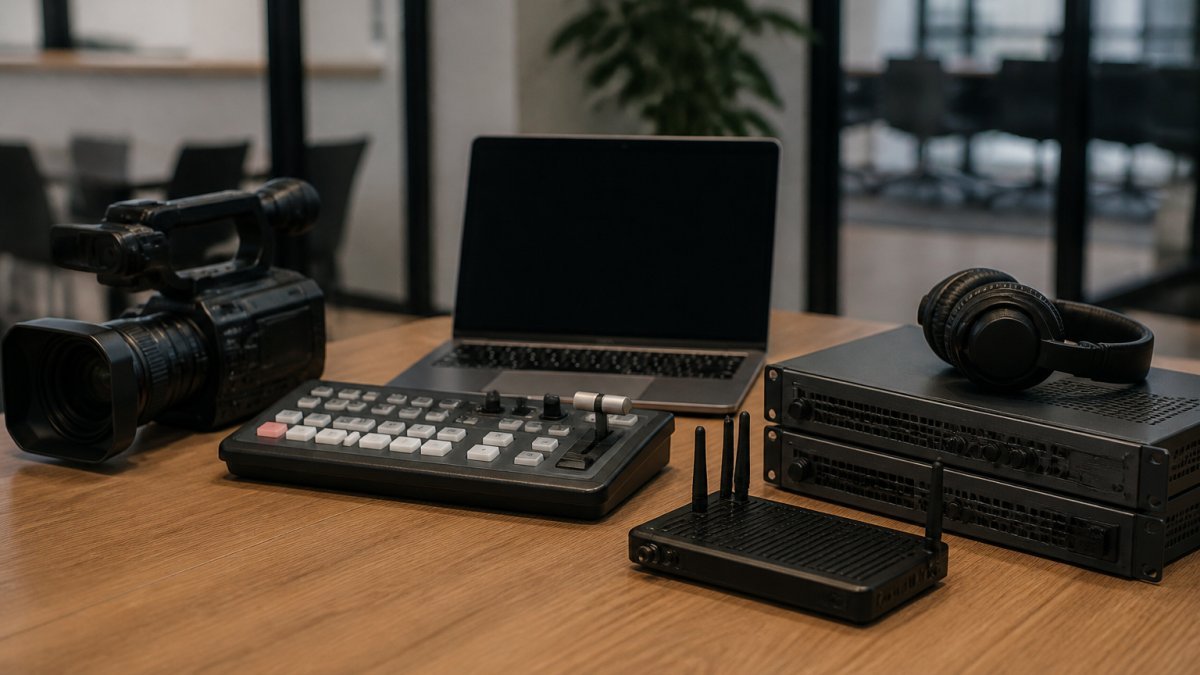
Reliability under scrutiny means the AGM stream survives a network failure, a power issue, or a last-minute change of presenter. The only credible proof is a rehearsed failover: a backup encoder ready to take over, a second connection path, and a technician who can switch without the audience noticing.
A common mistake is treating the AGM as a one-off technical task rather than a high-stakes broadcast. Our best practices for town hall webcasts guide covers the rehearsal checklist we use for high-stakes broadcasts.
Webcast Recording and On-Demand Access: Who Owns the Content
You should own the webcast recording outright, with no reuse fees and no lock-in to the provider’s hosting. Ownership means the file is delivered to you after the event, in a format you can reuse for training, internal briefings, or regulatory records. Anything less is a hidden cost.
On-demand access is where ownership pays off. A recording you control can be posted to your investor page, edited into highlights, and archived for years without asking permission. Before signing, confirm in writing that recordings are included at no extra cost and that you receive the source files.
Ask for a sample recording delivery from a past event. If the provider hesitates, the files are probably locked behind their platform.
Conclusion
The real test of an investor relations webcast is not the feature list but the moment something goes wrong, and whether your provider has a rehearsed answer. Webcasting Livestream handles that risk for you with a no drop-off guarantee, fail-safe procedures, HD quality streaming across all devices, and full recording ownership at no extra cost. Get a quote and we will walk you through the failover plan for your next AGM or earnings call.
Frequently Asked Questions
What should an investor relations webcast platform include?
A reliable webcast platform for investor relations should cover live and on-demand viewing, registration and authentication, moderated Q&A, engagement tracking, recording ownership and failover procedures. For annual general meetings, add secure access controls and accessibility features such as captions and transcripts. Confirm the platform can handle your peak concurrent viewership and that recordings are provided without extra fees. Ask for a documented incident response plan and a service level agreement before committing.
How do you choose a reliable platform for an investor webcast?
Start with reliability evidence: uptime commitments, failover architecture and named support staff available during the event. Then check whether the platform is purpose-built for investor communication, including earnings call workflows, shareholder meeting registration and on-demand replay. Request a live rehearsal under your network conditions and ask what happens if the primary stream fails. Pricing depends on audience size, event dates and production scope, so request a quote rather than comparing headline rates.
How can companies make investor webcasts secure and accessible?
Use a secure webcast platform with registration verification, single sign-on where appropriate, encrypted streaming and role-based access for internal communications. For public investor updates, balance open access with anti-scraping controls. Accessibility matters too: provide live captions, transcripts and keyboard-navigable player controls. Check that the platform supports screen readers and mobile playback at HD quality. Document your access controls so they align with your continuous disclosure obligations and internal communications policy.
Can an investor relations webcast be recorded and shared afterwards?
Yes. Webcast recording and on-demand access should be confirmed in the contract, including who owns the recording and whether download fees apply. A reliable provider records every stream and supplies the files at no extra cost, which matters for training, internal review and investor updates. Ask about storage duration, replay quality and whether the on-demand player supports captions. For shareholder meetings, check that the recording can be published promptly after the event.
How do you measure engagement during an investor webcast?
Track viewership numbers, average watch time, drop-off points, Q&A participation and replay views. Engagement metrics help you judge whether the format and timing worked and whether investors stayed for the full presentation. Compare live versus on-demand viewing to plan future investor updates. A reliable platform should give you these analytics after the event without manual assembly, and the data should be exportable for your communications strategy reporting.