
Table of Contents
- Why AGM Live Streaming Has Become Standard Practice
- Virtual AGM Compliance Requirements You Must Meet
- AGM Live Streaming Equipment Checklist
- Secure Online Voting Platforms for AGMs
- How to Manage Q&A in Virtual AGMs
- Choosing the Right AGM Live Streaming Solution
- Conclusion
Last Updated: August 13, 2026
Why AGM Live Streaming Has Become Standard Practice
Live streaming solutions for AGM meetings have shifted from a pandemic-era workaround to a permanent fixture in corporate governance. Shareholder engagement improves when participation barriers drop. Webcasting Livestream has worked with ASX-listed companies long enough to see attendance and proxy lodgement rates climb when shareholders can join from any device.
Corporate transparency is increasingly scrutinised by institutional investors, proxy advisers, and regulators. A meeting that only accommodates those who can travel to a physical venue creates an accountability gap. Hybrid and virtual formats close that gap.
Meeting minutes, voting records, and on-demand replay archives create a verifiable paper trail that satisfies internal audit requirements and external reporting obligations. A live webcast is now a corporate governance asset, not just a broadcast tool.
The production quality of your AGM stream signals something about your organisation. A dropped stream, pixelated video, or garbled audio during a resolution vote raises questions about operational competence. Low-latency streaming with broadcast-grade audio-visual integration is now the baseline expectation.
Virtual AGM Compliance Requirements You Must Meet
Virtual AGM compliance requirements are not optional considerations. They are the starting point. Getting this wrong exposes your organisation to legal challenge from shareholders and potential regulatory sanction.
Corporations Act 2001 and Hybrid Meeting Rules
The Corporations Act 2001 provisions on meetings governs how companies must conduct general meetings. Amendments have established a permanent framework for hybrid meetings, allowing shareholders to attend and participate electronically without losing legal validity.
Several conditions must be met. The technology must give shareholders a reasonable opportunity to participate in real time, including the ability to hear and, where practicable, see proceedings. Shareholders must be able to vote on resolutions during the meeting. The platform must support a verifiable quorum count that includes both in-person and remote attendees.
A common mistake is treating the livestream as broadcast-only and handling voting separately through proxy mechanisms. Real-time interaction, not passive viewing, is the compliance threshold the Act requires.
ASX Listing Rules and Corporate Governance Obligations
For ASX-listed entities, the ASX Corporate Governance Principles and Recommendations add another layer of obligation. The fourth edition recommends that listed entities take reasonable steps to facilitate shareholder participation and engagement, which directly implicates your AGM streaming infrastructure quality.
Listing Rule 3.1 requires continuous disclosure of material information, and your AGM is a primary venue for that disclosure. A stream that fails mid-meeting or cannot be replayed on demand creates a disclosure risk. The on-demand replay requirement is therefore a governance safeguard, not merely a convenience feature.
Corporate secretaries should note that the ASX expects listed entities to publish meeting results promptly after the meeting closes. Your streaming platform and voting system need to produce exportable data that feeds directly into that reporting workflow.
AGM Live Streaming Equipment Checklist
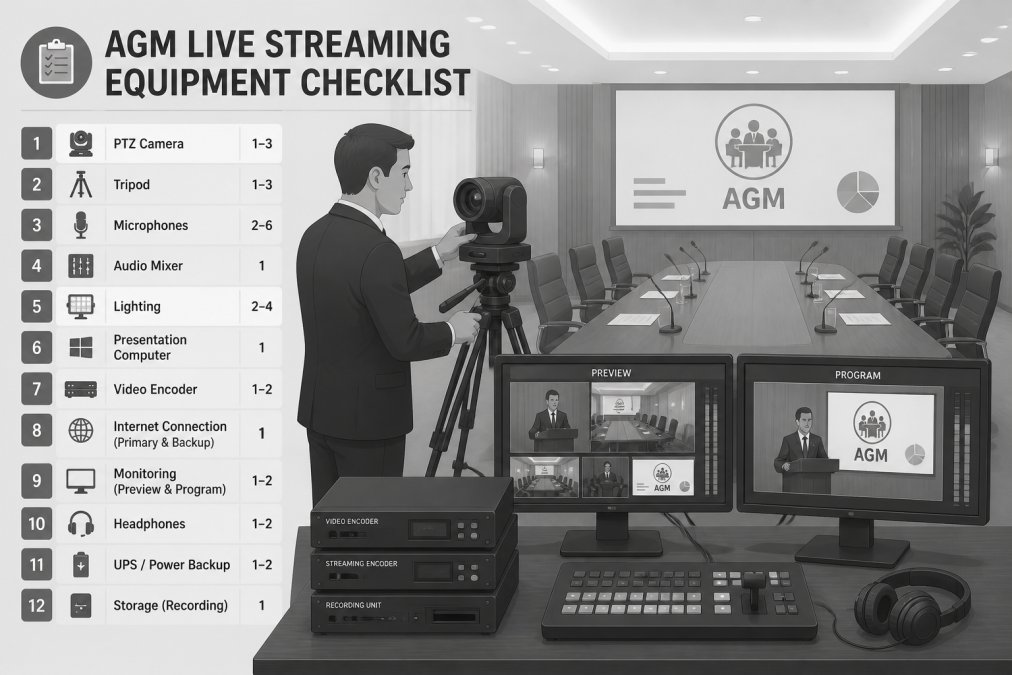
The right equipment separates a compliant meeting from a credible one. Many organisations satisfy the legal threshold but deliver an experience that undermines shareholder confidence. Broadcast-grade hardware is the difference.
Cameras, Audio, and Broadcast-Grade Hardware
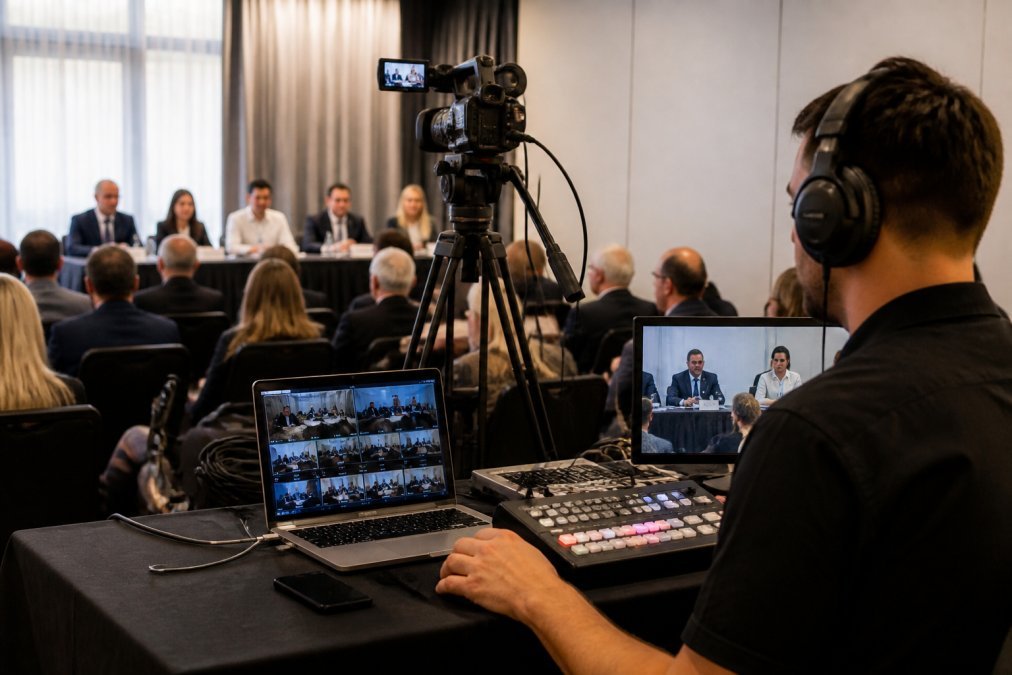
PTZ cameras with HDR sensors handle the high-contrast lighting conditions common in boardrooms. A single fixed-angle camera will miss reaction shots and audience questions. Multi-camera production with a minimum of two to three camera positions is the practical standard for AGMs with significant shareholder audiences.
Audio is the element most likely to destroy an otherwise solid production. Lavalier microphones on the chair and company secretary, combined with directional microphones for the floor, give clean audio capture. Integration with the venue’s existing PA system via direct feed eliminates echo and feedback that wireless setups introduce.
Additional hardware essentials include:
- Hardware encoder: Converts the camera signal to a streaming protocol without relying on a laptop’s processing capacity
- Dedicated streaming PC or appliance: Separate from the presentation computer to avoid resource conflicts
- Confidence monitor: Allows the chair and board to see what shareholders see on the stream
- Backup recording device: Local recording independent of the internet connection
- Uninterruptible power supply (UPS): Protects against venue power fluctuations
Connectivity, Bandwidth, and Hardware Redundancy
Uplink stability is where most AGM streams fail. A single internet connection is a single point of failure. For a meeting where a dropped stream could invalidate a resolution, hardware redundancy is not optional.
A bonded connection combines multiple internet sources (fibre, 4G, 5G) into a single reliable uplink. Bandwidth requirements for a multi-camera HD stream typically exceed standard office connections. Conduct a pre-event uplink test from the venue at least 48 hours before the meeting.
The production setup should include automatic failover to a backup encoder and secondary uplink if the primary fails.
Secure Online Voting Platforms for AGMs
Secure online voting platforms must satisfy three distinct requirements: identity verification, vote integrity, and audit trail completeness.
Attendee authentication is the first control. Shareholders must be verified against the share register before voting. This typically involves shareholder reference numbers, unique access codes, and sometimes two-factor authentication.
Vote integrity means the system records each vote accurately, applies correct weighting for share classes, and cannot be altered after submission. Real-time weighted voting allows results to be displayed immediately after the poll closes.
The audit trail requirement includes login timestamps, vote records, Q&A submissions, session durations, and technical incidents. This data is essential if a resolution is challenged or a regulatory body requests evidence of proper meeting conduct.
End-to-end encryption is the minimum security standard. Data transmitted between shareholders and the platform must be encrypted in transit, and stored data must be protected at rest. Platforms must comply with the Australian Privacy Act 1988 and the Australian Privacy Principles.
Requirement | What to Verify | Why It Matters |
|---|---|---|
Attendee authentication | Shareholder register integration, unique access codes | Prevents duplicate or unauthorised votes |
Real-time weighted voting | Automatic share-class weighting, instant results display | Eliminates manual tallying errors |
Audit trail completeness | Login timestamps, vote records, Q&A logs | Supports post-meeting compliance reporting |
End-to-end encryption | Encryption in transit and at rest | Protects sensitive shareholder data |
Quorum verification | Real-time headcount of in-person and remote attendees | Ensures meeting has legal standing to proceed |
How to Manage Q&A in Virtual AGMs
Managing Q&A in virtual AGMs is the part of the process most organisations underestimate until something goes wrong on the day. The challenge is procedural, not technical.
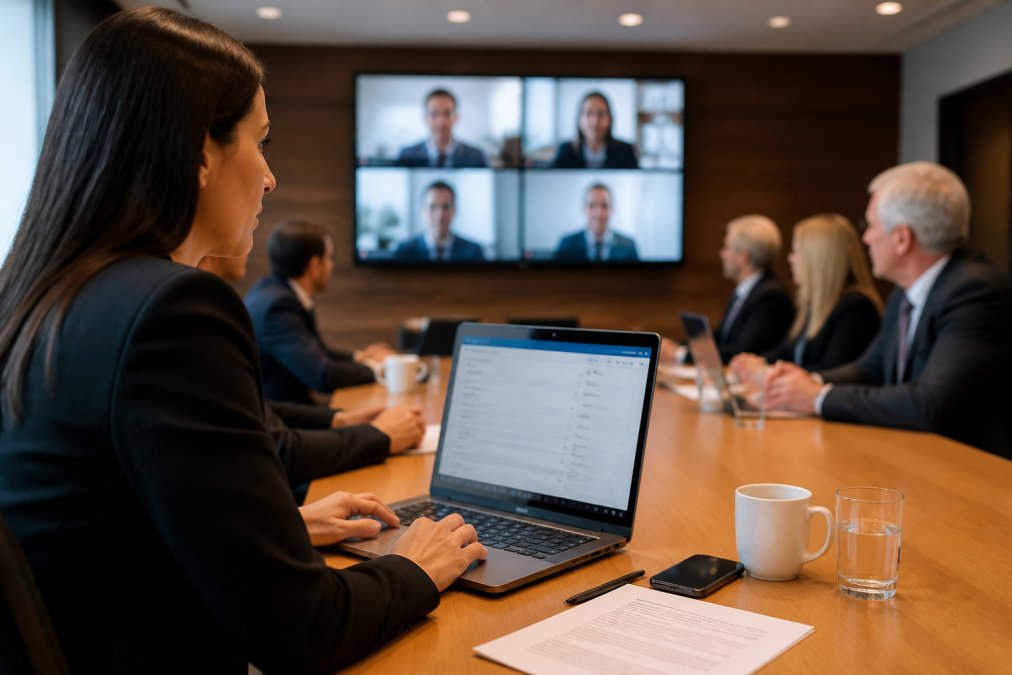
The most reliable approach separates the Q&A moderation role from the chair’s role entirely. A dedicated moderator reviews incoming questions, filters duplicates, groups similar questions, and presents them to the chair in a structured queue.
Practical steps for a compliant and efficient virtual AGM Q&A process:
- Pre-meeting question submission: Open a question portal 24-48 hours before the meeting to allow preparation of considered responses.
- Assign a dedicated moderator: This person manages the digital Q&A queue exclusively.
- Establish a question priority protocol: Address questions from verified shareholders before observers. Prioritise questions on agenda items in order.
- Use a phone audio backup queue: For shareholders unable to use the digital interface, a managed phone queue ensures accessibility.
- Set time limits per question: Communicate these in the notice of meeting.
- Record all submitted questions: Log even questions not answered live and respond to them in writing post-meeting.
- Archive the Q&A transcript: Include it in meeting minutes and make it available with the on-demand replay.
Real-time interaction quality is a direct measure of shareholder engagement. A Q&A process that feels managed and fair builds confidence.
Choosing the Right AGM Live Streaming Solution
The right live streaming solution is not the one with the longest feature list. It is the one that matches your organisation’s scale, compliance obligations, and technical capacity on the day.
Webcasting Livestream provides professional, end-to-end live streaming solutions built specifically for high-stakes corporate events where failure is not an option. The service includes fail-safe procedures, HD quality streaming across all devices, and a no-drop-off guarantee backed by redundant infrastructure. All video is recorded and provided at no extra cost, and your organisation retains full ownership of the content.
Key differentiators to assess are:
- Managed versus self-service: A fully managed service means an experienced technical team handles the production on site.
- Production quality: Multi-camera setups with broadcast-grade hardware produce a materially better experience than a single webcam feed.
- Redundancy architecture: Ask specifically how the provider handles a primary connection failure.
- Content ownership: Confirm that recordings are delivered to you without additional fees and that the provider does not retain rights to your content.
Accessibility, Archiving, and Post-Meeting Reporting
Accessibility is a compliance consideration. The Web Content Accessibility Guidelines (WCAG) 2.2 provide the international standard against which digital meeting interfaces should be assessed. For listed entities, this includes closed captioning for the live stream, keyboard-navigable interfaces, and sufficient colour contrast on voting interfaces.
On-demand replay serves two purposes. For shareholders who could not attend live, it is a participation mechanism. For the organisation, it is a compliance record. The replay should be available within 24 hours and remain accessible consistent with your document retention policy.
Post-meeting reporting should draw directly from your streaming and voting platform data. A complete report includes final voting results with share-weighted tallies, attendance records, a Q&A transcript or summary, and any technical incident log. This feeds into your ASX announcement obligations and board governance review.
Cybersecurity and Data Protection
Cybersecurity for AGM streaming includes the streaming platform, voting system, authentication mechanism, and venue network infrastructure.
Practical risk mitigation steps are:
- Platform access controls: Only authenticated shareholders should reach the live stream.
- Unique access credentials: Each shareholder should receive a unique, single-use access link or code.
- Network segmentation at the venue: Isolate the streaming production network from the venue’s general guest Wi-Fi.
- Incident response protocol: Your streaming provider should have a documented procedure for security incidents during a live event.
Data collected during the meeting, including shareholder identity, voting records, and Q&A submissions, is personal information under the Australian Privacy Act 1988. Your provider must confirm where this data is stored, who can access it, and how long it is retained.
Managing the technical complexity of a live AGM while running a compliant, engaging meeting is a significant operational challenge. Webcasting Livestream handles the end-to-end production, from pre-event site surveys and equipment setup to live moderation support and post-meeting recording delivery, so your corporate secretarial and IR teams can focus on the meeting itself. With a no-drop-off guarantee, full content ownership, and HD quality across all devices, it is the managed service built for organisations where stream failure is not an acceptable outcome. Get a quote from Webcasting Livestream today.
Frequently Asked Questions
Can an AGM be held virtually under the Corporations Act 2001?
Yes. Amendments to the Corporations Act 2001, made permanent through the Treasury Laws Amendment (Modernising Business Communications and Other Measures) Act 2023, allow companies to hold fully virtual or hybrid AGMs. Shareholders must be given a reasonable opportunity to participate, ask questions, and vote in real time. The notice of meeting must specify how remote shareholders can join, and the platform must support live two-way interaction to satisfy quorum and participation requirements.
What equipment is required for a professional AGM live stream?
A professional AGM live stream requires broadcast-grade cameras with HDR sensors, a dedicated audio mixer integrated with the room's PA system, a hardware encoder, and a primary plus backup internet uplink for hardware redundancy. A multi-camera production setup is standard for larger venues. You will also need a streaming platform, attendee authentication tools, and a secure voting interface. Managed service providers supply and operate all of this equipment, removing the burden from your internal IT team.
How do you ensure secure voting during a live-streamed AGM?
Secure online voting for AGMs relies on attendee authentication at login, end-to-end encryption of all data in transit, and a comprehensive audit trail of every vote cast. Purpose-built AGM platforms support real-time weighted voting, proxy pre-voting integration, and instant result displays. Look for platforms that comply with Australian corporate governance standards and produce exportable reports for the company secretary and auditors. Avoid general-purpose video conferencing tools that lack these governance controls.
How can companies maintain shareholder engagement during virtual AGMs?
Shareholder engagement in virtual AGMs improves significantly when interactive features are built into the broadcast. Live polling, moderated Q&A with a digital submission queue, real-time voting displays, and a low-latency stream all reduce the passive viewing experience. Sending pre-meeting communications with clear joining instructions, offering on-demand replay after the meeting, and providing live technical support during the event also increase participation rates and reduce shareholder frustration.
What are the legal requirements for hybrid or virtual AGMs?
Under the Corporations Act 2001 as amended, hybrid and virtual AGMs must allow shareholders to attend, participate, and vote in real time regardless of their physical location. The meeting must achieve quorum, and shareholders must be able to submit questions and hear responses live. ASIC has issued guidance confirming that technology failures that prevent participation can invalidate resolutions, making uplink stability, hardware redundancy, and a tested fail-safe streaming setup legally significant, not just a production preference.
How many concurrent viewers can a professional AGM live stream handle?
Professionally managed AGM webcasting services are built to scale well beyond typical meeting sizes. Broadcast-grade content delivery networks distribute the stream so that viewer count does not degrade quality or cause platform crashes. Whether you are expecting 500 or 5,000 concurrent viewers, the key factors are the CDN capacity of your provider, the uplink bandwidth at the venue, and whether the platform has been load-tested at your expected scale. Confirm these specifications with your provider before the event.
This article was written using GrandRanker