

Table of Contents
- Why Live Streaming AGMs Matters for Modern Governance
- Virtual AGM Compliance Requirements Under Australian Law
- Essential Technical Setup for Live Streaming AGMs
- AGM Live Streaming Checklist: Pre-Event Preparation
- Online Voting Platforms for AGMs: Integration and Security
- Hybrid Meeting Configurations and Stakeholder Engagement
- Promoting Your AGM to Shareholders and Stakeholders
- Post-AGM Reporting and Record-Keeping
Last Updated: August 17, 2026
Why Live Streaming AGMs Matters for Modern Governance
Annual general meetings have fundamentally changed. Companies streaming their AGMs see measurably higher participation rates and broader shareholder engagement than those limiting attendance to physical venues. However, a properly executed live stream requires coordination between technical infrastructure, legal compliance, security protocols, and audience engagement strategies that most organisations underestimate.
At Webcasting Livestream, we’ve managed hundreds of corporate AGMs across Australia. Organisations that treat live streaming as an afterthought struggle with dropped connections, poor audio quality, voting integration failures, and compliance gaps that create legal liability. Those that plan systematically deliver shareholder experiences that strengthen trust and participation.
This guide covers the complete framework for best practices for live streaming AGMs, from pre-event technical rehearsals through post-meeting record-keeping.
Virtual AGM Compliance Requirements Under Australian Law
Streaming an AGM isn’t purely technical. Australian corporations legislation and ASX listing rules impose specific requirements on how you conduct, record, and archive virtual meetings.
The Corporations Act 2001 (Cth) permits companies to hold meetings using technology, but the technology must allow all participants to communicate concurrently. Remote shareholders must be able to ask questions, raise points of order, and participate in voting in real time.
For listed companies, ASX Guidance on virtual meetings requires authenticated participant access, audit trails of all votes and questions, and a complete recording preserved for at least three years and available for ASIC inspection.
Key compliance obligations are:
- Real-time participation: Remote shareholders must have the same ability to speak, question, and vote as those physically present
- Authentication and verification: Confirm participant identity and ensure voting rights are properly allocated
- Audit trails: Log every vote, question submission, and speaker with timestamps
- Recording retention: Keep recordings for at least three years and make available to regulators on demand
- Accessibility: Provide captions for deaf participants and audio descriptions for visually impaired shareholders
Standard video conferencing platforms lack governance-specific features. They don’t generate audit trails suitable for regulatory inspection, don’t integrate with proxy voting systems, and don’t preserve precise voting records ASX requires. Dedicated AGM platforms like Azeus ConveneAGM and Lumi Global are purpose-built for Australian AGM compliance. Alternatively, professional streaming providers like Webcasting Livestream integrate with voting systems, maintain compliant audit trails, and handle authentication and recording retention.
Failing to maintain proper audit trails or allowing participants to vote without authentication creates regulatory risk. ASIC has issued enforcement actions against companies that could not produce voting records for shareholder disputes. Budget compliance infrastructure before you budget video quality.
Essential Technical Setup for Live Streaming AGMs
The technical foundation determines whether shareholders see a professional broadcast or a pixelated mess with audio dropout.
Audio and Video Quality Standards
Video quality must meet professional broadcast standards. Target 1080p minimum (1920 × 1080 pixels) at 30 frames per second with 4-6 Mbps bitrate. 4K is preferable for presentations with on-screen text, but 1080p is the practical baseline.
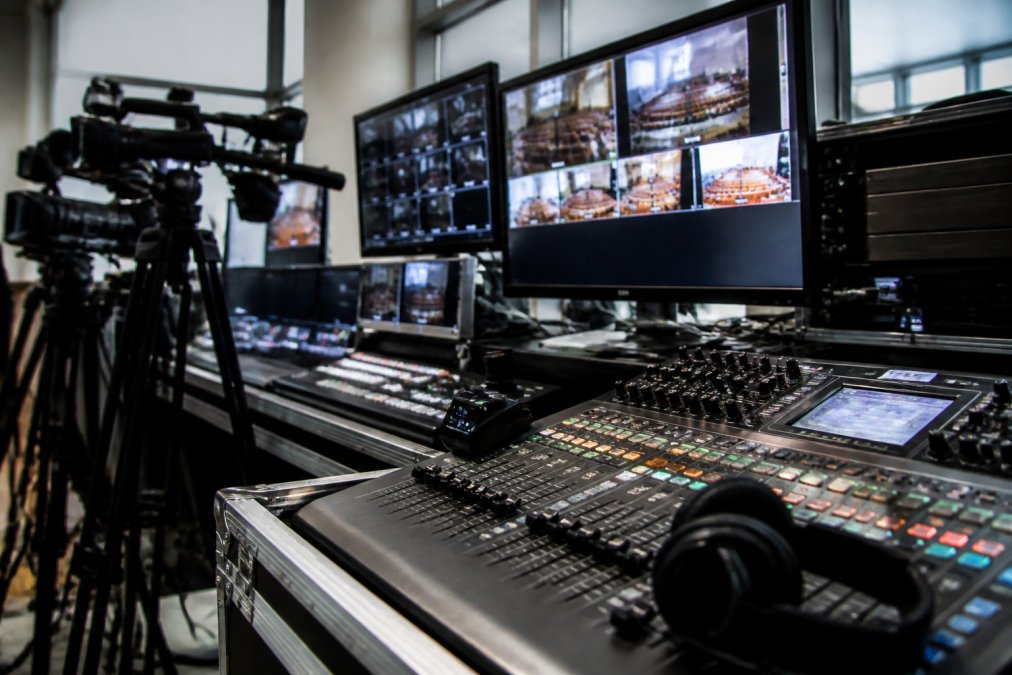
Audio is often overlooked and frequently the biggest source of complaints. Professional AGM broadcasts require dedicated microphone setup: lavalier mics on speakers, boundary mics on the board table, and a handheld mic for audience questions. These feeds go through a mixing console where levels are balanced, feedback is eliminated, and a clean stereo mix is sent to the stream. Target 48 kHz sample rate, 16-bit depth, stereo minimum, with peak levels at -6dB to -3dB.
Network Infrastructure and Redundancy
Internet failure during an AGM is catastrophic. Redundancy is non-negotiable.
Proper network infrastructure requires:
- Primary connection: NBN or business-grade fibre, minimum 25 Mbps upload capacity
- Secondary connection: Independent ISP or 4G/5G mobile backup
- Uninterruptible Power Supply (UPS): Protects network equipment from power interruption
- Load balancing: Distributes traffic across connections and automatically fails over if one drops
- Local Area Network (LAN): Hard-wired Ethernet connections for all streaming equipment
Office internet designed for email and web browsing is inadequate for pushing 8 Mbps of video upstream. You need dedicated bandwidth for the stream, isolated from general office use. If streaming 1080p at 6 Mbps with 50% headroom for overhead, you need 9 Mbps minimum upload capacity on your primary connection.
Test your actual upload speed at the venue during off-peak and peak business hours. Upload speed often drops 20-40% during peak times. Plan for worst-case capacity.
Pre-Event Testing and Technical Rehearsals
A technical rehearsal is the difference between a smooth broadcast and a disaster. Schedule a full run-through at least 48 hours before the AGM with all speakers, cameras, slides, and voting systems active.
During the rehearsal:
- Test all cameras, switching, and microphones
- Test all slides and graphics for readability
- Test voting integration and Q&A systems
- Test streaming output to all target platforms
- Intentionally disconnect the primary internet and confirm secondary connection takes over within 10 seconds
- Test recording capture and backup location
Document every issue found and resolve it before the event. Allocate 2-3 hours for a thorough rehearsal; 4 hours for complex setups with multiple venues.
AGM Live Streaming Checklist: Pre-Event Preparation
Registration and Member Verification
Shareholders participating remotely need a registration process that captures their identity and confirms shareholding. Registration should be live at least one week before the AGM.
The registration system must:
- Verify shareholding against your shareholder registry
- Assign voting rights based on shareholding quantity
- Prevent duplicate voting
- Support proxies
- Generate audit trails with timestamps
On the day of the AGM, registration should close 15 minutes before the meeting starts. This prevents last-minute registrations that confuse the voting audit trail.
Roles and Responsibilities of the Management Team
Every person involved needs a clear role:
- Meeting Chair: Runs the meeting, introduces speakers, manages timing
- Streaming Producer: Monitors broadcast quality, manages camera switching
- Audio Technician: Manages microphone levels, monitors for feedback
- Voting Administrator: Monitors voting system, confirms recording, announces results
- Q&A Moderator: Monitors incoming questions, filters submissions, feeds relevant questions to Chair
- Technical Support Lead: Oversees all technical systems, activates failover if needed
- On-Site AV Technician: Manages cameras, slides, and graphics
Create a run-of-show document listing every agenda item, speaker, duration, slides, and next steps. Distribute this at least one day before and walk through it during the technical rehearsal.
Online Voting Platforms for AGMs: Integration and Security
Voting is the legal core of an AGM. If voting fails, the entire meeting fails.
Proxy Voting and Real-Time Polling Mechanisms
Shareholders vote three ways: in person, remotely via the online platform, or via proxy. Your voting platform must support all three simultaneously.
Key voting platform features:
- Weighted voting: Shareholders with more shares get proportionally more votes
- Proxy support: Allow shareholders to appoint a proxy and prevent duplicate voting
- Multiple voting methods: Support in-person, online, and postal votes in a single system
- Immediate results: Display vote totals and percentages as soon as the poll closes
- Audit trail: Log every vote with voter identity, timestamp, and resolution
For most Australian AGMs, dedicated platforms like Azeus ConveneAGM or Lumi Global are preferable to generic voting tools.
Security and Data Privacy Protocols
Shareholder data is sensitive and must be protected from unauthorised access, interception, and breach.
Security requirements:
- Authentication: Shareholders must log in with unique password or single sign-on; two-factor authentication adds an extra layer
- Encryption in transit: All data between shareholder’s device and voting platform must use TLS 1.2 or higher
- Encryption at rest: Voting data stored on servers must be encrypted
- Access controls: Implement role-based access so staff can only see data relevant to their role
- Data retention: Delete voting data after the required retention period (typically three years)
- Backup security: Backups must be encrypted and stored separately from production systems
A data breach of shareholder information creates regulatory liability and shareholder lawsuits. Invest in security upfront. It’s far cheaper than managing a breach after the fact.
Hybrid Meeting Configurations and Stakeholder Engagement
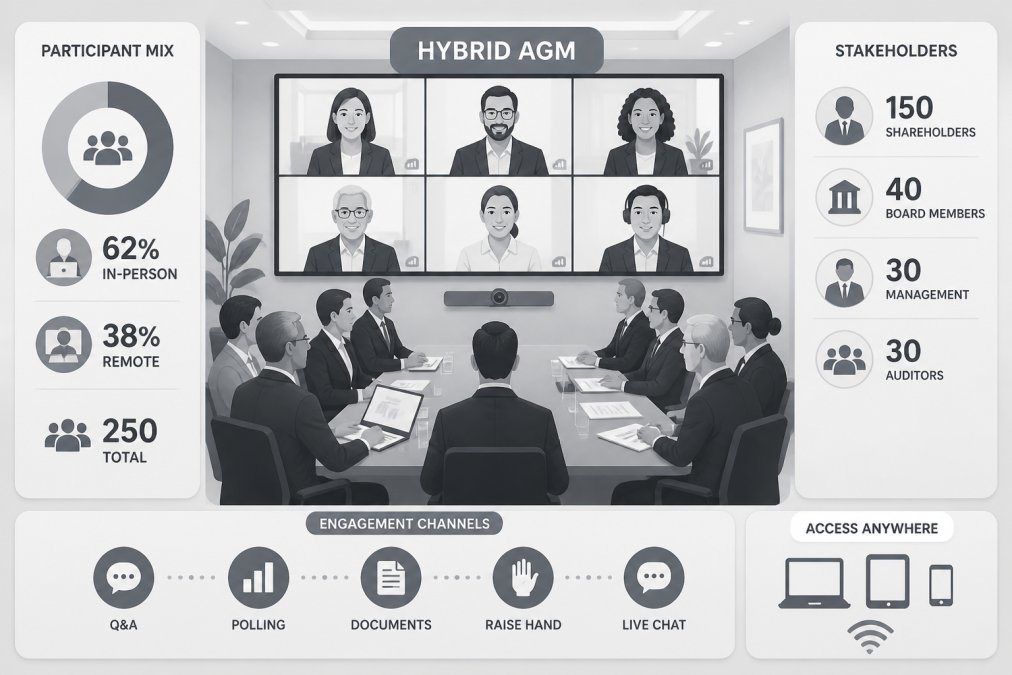
Most modern AGMs are hybrid: some shareholders attend in person, others join remotely. This creates complexity but also flexibility.
Managing In-Person and Virtual Participants
Remote participants experience the meeting differently than those in the boardroom. Design specifically to equalise the experience:
- Dedicated camera for remote participants: Use a camera operator who adjusts framing as speakers move
- Large screen for remote speakers: Display remote speakers on a large screen so in-person participants see them clearly
- Microphones for all speakers: Every speaker must use a microphone
- Repeat all questions: When an in-person shareholder asks a question, the Chair repeats it so remote participants hear it
- Timing for both audiences: Allow time for remote participants to unmute and ask questions
Real-Time Interaction and Q&A Management
Structure Q&A explicitly:
- Dedicated Q&A time: Allocate specific time blocks for Q&A after each major agenda item
- Visible question queue: Display pending questions on-screen so both in-person and remote participants can see what’s been asked
- Priority system: Prioritise questions relevant to the current agenda item
- Time limits: Set a time limit per question (e.g., 2 minutes for the answer)
- Written follow-up: If a question can’t be answered during the meeting, commit to answering it in writing within a specified timeframe
For large AGMs (500+ shareholders), a professional Q&A moderator is essential.
Promoting Your AGM to Shareholders and Stakeholders
An AGM only works if shareholders show up. Promotion starts weeks before:
- Initial notice: Send the AGM notice and agenda to all shareholders at least 28 days before (required by Corporations Act). Include how to register for remote participation
- Reminder emails: Send reminders one week before and three days before
- Registration incentive: Highlight the benefits of remote participation
- Technical support: Publish a simple guide on how to join, vote, and ask questions
- Social media: Promote the AGM on LinkedIn or other channels if appropriate
The goal is to maximise participation. Higher attendance improves the legitimacy of decisions and demonstrates shareholder engagement to regulators.
Post-AGM Reporting and Record-Keeping
The AGM doesn’t end when the last shareholder logs off. You have legal obligations to report and preserve records.
Immediate Post-Event Actions
Within 24 hours:
- Verify the recording was captured correctly
- Secure the recording to a backed-up location
- Generate the voting report with audit trail
- Prepare the minutes documenting resolutions passed, voting results, and significant discussion
Regulatory Reporting
Within 3 business days, listed companies must lodge a notice with ASX disclosing voting results, proxy voting breakdown, and any technical issues that affected participation.
Record Retention
Keep the following for at least three years:
- The complete recording
- Official minutes signed by the Chair
- Complete voting audit trail
- Shareholder register snapshot as at record date
- All Q&A submissions and answers
- Technical logs showing uptime and issues
| Document | Retention Period | Storage Location |
|---|---|---|
| Recording | 3+ years | Secure encrypted server, backed up offsite |
| Minutes | Permanent | Corporate records archive |
| Voting audit trail | 3+ years | Voting platform, backed up separately |
| Shareholder register snapshot | 3+ years | Corporate records archive |
| Q&A submissions | 3+ years | Voting platform or email archive |
| Technical logs | 1 year | Network equipment or cloud storage |
Post-AGM record-keeping is where many organisations slip. The meeting went well and record-keeping feels like paperwork. But regulators expect complete, organised records. Budget time and resources for this before the meeting happens.
Conclusion
Live streaming an AGM successfully requires coordination across technical infrastructure, legal compliance, security, and stakeholder engagement. Organisations that get it right treat the AGM broadcast as a core governance function, not an afterthought. They invest in redundant internet infrastructure, conduct full technical rehearsals, define clear roles, and maintain compliant records.
If you’re managing an AGM and want to ensure a professional, secure, compliant broadcast, Webcasting Livestream provides end-to-end live streaming solutions with fail-safe procedures that guarantee seamless delivery. Our team handles multi-camera production, voting integration, compliance archiving, and 100% uptime guarantees, so your AGM runs flawlessly. Get a quote from Webcasting Livestream and let our experts manage the broadcast while you focus on governance.
Frequently Asked Questions
Are virtual AGMs legally permitted under Australian law?
Yes. The Corporations Act permits companies to hold virtual or hybrid AGMs, provided they comply with specific requirements. Directors must ensure shareholders can participate, vote, and ask questions in real time. Your AGM platform must support authentication, quorum verification, and secure proxy voting. Consult your company secretary or legal team to confirm your meeting structure meets Corporations Act obligations, particularly around shareholder rights and transparency.
What are the essential technical requirements for a professional AGM live stream?
A professional AGM live stream requires HD video quality (minimum 1080p), high-quality audio with multiple microphones, redundant internet connectivity (bonded connections prevent stream failure), uninterruptible power supply, and backup streaming equipment. You'll also need a reliable streaming platform with security features like password protection and registration. Pre-event technical rehearsals with all speakers, presenters, and technical staff are critical to catch issues before the broadcast begins.
How do you ensure secure voting during a live-streamed AGM?
Secure voting requires multi-factor authentication, encrypted data transmission, and audit trails for all votes cast. Your online voting platform must verify shareholder identity, prevent duplicate voting, and maintain real-time vote tallying with immediate result display. Platforms should support both proxy voting and live voting during the broadcast. Ensure your provider uses industry-standard encryption and complies with ASX guidelines for listed companies. Test all voting mechanisms thoroughly during pre-event rehearsals.
What should we include in our AGM live streaming checklist?
Your checklist should cover: shareholder registration and member verification processes, speaker briefs and media training, technical rehearsals with all equipment, backup internet and power systems, camera positioning and screen sharing setup, polling and voting platform testing, Q&A moderation protocols, recording and archiving procedures, accessibility features (captions, audio descriptions), and post-event reporting templates. Assign clear roles to your management team, designate a technical lead, moderator, and backup operator. Test everything at least 48 hours before the event.
What accessibility standards should we meet for a live-streamed AGM?
Ensure live captions or subtitles are available for all spoken content, provide audio descriptions for visual elements, use accessible colour contrasts and font sizes on screen, and ensure your streaming platform is keyboard-navigable. Offer multiple ways for shareholders to participate: text-based Q&A, live chat, email submissions, and phone dial-in options. Test accessibility features with users who have disabilities before the event. Compliance with these standards broadens participation and demonstrates commitment to inclusive governance.
How much technical support will we need to provide from our IT team?
This depends on your provider. A fully managed service like Webcasting Livestream handles production, streaming infrastructure, and troubleshooting on their end, your IT team mainly ensures your internal network is stable and that speakers have reliable connections. Conversely, if you're self-managing via a platform like Zoom or Teams, your IT team will need to configure the event, manage attendee access, troubleshoot issues, and handle recording storage. Clarify with your provider what support responsibilities fall on you versus them before signing up.
What happens if the stream fails during our AGM?
Professional providers like Webcasting Livestream offer 'no drop-off guarantees' backed by redundant systems: bonded internet connections (multiple ISP lines), backup power supplies, and failover streaming equipment. If primary systems fail, backup systems activate automatically with no interruption to viewers. Ask your provider for their specific failover procedures, response times, and what happens if failure occurs despite precautions. Request documentation of their uptime track record and ask for references from similar-sized AGMs they've streamed.
This article was written using GrandRanker