
Table of Contents
- Why Professional Event Streaming Matters for Australian Businesses
- Professional Event Live Streaming Services: What Sets Them Apart
- Event Streaming Platforms vs Full-Service Production Companies
- Hybrid Event Production: Blending In-Person and Virtual Audiences
- Key Capabilities to Evaluate: Multistreaming, Recording, and Redundancy
- Event Production Quote Checklist: What to Ask Before You Commit
- Making Your Final Decision: Reliability, Support, and Regional Coverage
- Frequently Asked Questions
Last Updated: October 14, 2026
Why Professional Event Streaming Matters for Australian Businesses
Professional event streaming is now essential for organisations across Australia. Whether you’re hosting a corporate AGM, product launch, or hybrid conference, broadcast quality shapes how your audience perceives your brand: a flawless stream builds credibility, while failures damage it.
The challenge isn’t finding a streaming solution, it’s finding one that reliably delivers without dropped connections or lost video quality. Many businesses have endured a critical event interrupted by stream failure, which is why professional event streaming services are non-negotiable for organisations that can’t afford downtime.
The difference between a forgettable broadcast and a seamless one comes down to three things: technical redundancy, professional management, and content ownership.
Professional Event Live Streaming Services: What Sets Them Apart
Professional event live streaming services differ fundamentally from consumer platforms. A professional provider manages every aspect of your broadcast, from camera setup and audio mixing to encoding and multi-platform distribution, so you don’t need technical expertise in-house.
The core difference is accountability. With a DIY platform, technical failures are your problem; with a professional service, uptime is guaranteed and contingency procedures are in place, which matters most during high-stakes events.
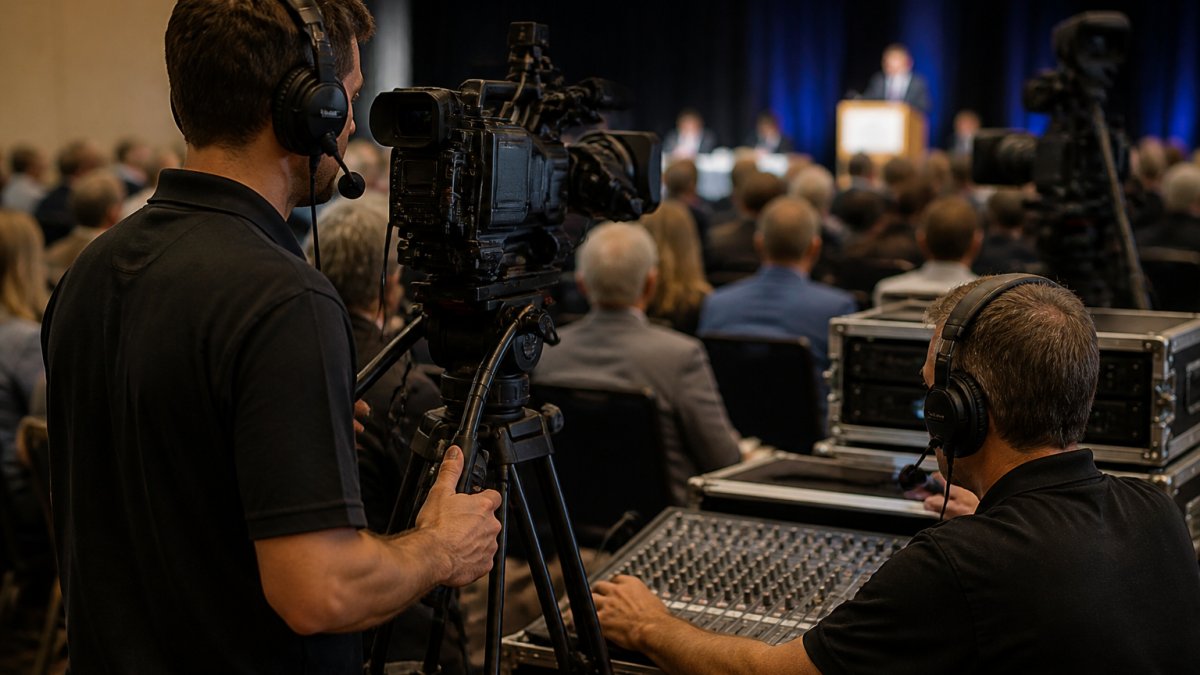
Key capabilities that separate professional providers include:
- Fail-safe redundancy: Multiple backup systems ensure your stream continues even if primary systems fail
- HD quality across all devices: Professional encoding adapts your broadcast to mobile, tablet, and desktop without quality loss
- Live recording and archiving: Your event is captured in full HD at no extra cost, ready for reuse in training or marketing
- Multi-camera production: Professional operators manage multiple camera angles, switching, and graphics in real time
- Secure, private streaming: Restricted access ensures sensitive internal communications stay confidential
Event Streaming Platforms vs Full-Service Production Companies
You have two paths: a self-service streaming platform or a full-service production company. Each has trade-offs, but the more useful question is which Australian production providers sit alongside The Streaming Guys, and how their scope differs.
The DIY path, in concrete terms
Self-service tools such as OBS Studio (free, open source), StreamYard, Restream, and Zoom Webinars put control in your hands: you supply the laptop, capture card, encoder settings, and contingency plan. Costs are modest, OBS is free, StreamYard and Restream sit around AUD $30-$100 per month for small teams, and Zoom Webinars is bundled into higher Zoom plans. These suit internal webinars where a dropped connection is inconvenient but not catastrophic.
What they do not supply is a crew, redundant encoders, venue audio integration, or a technical director watching the stream live. When something fails, you are the escalation path.
The full-service path, and who actually offers it
The Streaming Guys is one of several Australian providers offering end-to-end event production: crew, cameras, audio, lighting, encoding, multistreaming, recording, and on-site technical direction. Comparable providers include:
- Encore (formerly Staging Connections), large-format corporate and conference production, in-house AV at many major venues, national coverage.
- AVPartners, venue-partnered AV and event production, strong in hotels and conference centres.
- Microhire, corporate AV, conferences, and hybrid event production across major metro markets.
- Scene Change, creative event production and technical delivery for corporate and government events.
- Cvent / On24 / Hopin-style platforms, software-led, with optional production services layered on top.
- Boutique streaming specialists, smaller firms focused purely on live streaming and hybrid delivery, often with more flexible pricing than the large AV integrators.
Service scope varies widely: some bundle venue AV, staging, and lighting, while others focus narrowly on the broadcast layer. Some travel regionally, others price metro-only, and recording and content ownership may be standard or an add-on.
How to compare them fairly
Rather than comparing logos, compare four things:
- Scope, broadcast only, or broadcast plus venue AV, staging, and lighting?
- Crew model, in-house technicians or subcontracted freelancers? This affects consistency and cost.
- Coverage, metro-only, or do they routinely travel to regional and remote venues?
- Content ownership, do you receive master recordings with unrestricted reuse rights?
Ask each provider for two references from events similar in size and format to yours. A conference reference tells you little about how they handle a sensitive internal AGM.
The real question isn’t which is cheaper, it’s which aligns with your event’s importance. A routine training webinar might justify DIY streaming, but a product launch to 5,000 people, a regulatory AGM, or a sensitive internal announcement demands professional management, the cost of failure far exceeds the cost of professional service.
For organisations hosting multiple events per year, or events with large audiences, a full-service provider is usually more economical once you factor in staff time, troubleshooting, and the reputational cost of a failed stream.
Hybrid Event Production: Blending In-Person and Virtual Audiences
Hybrid events, where some attendees are in-person and others join remotely, require a different production approach. You’re essentially running two events simultaneously: the physical venue and the virtual broadcast.
This complexity is where professional event production services earn their value. Managing a hybrid event alone means juggling venue logistics, camera positioning, audio mixing, and viewer engagement across two separate experiences.
Professional hybrid production typically includes:
- Multi-camera setup capturing the stage, audience reactions, and speaker close-ups
- Professional audio ensuring remote viewers hear clearly despite venue acoustics
- Real-time graphics and lower thirds identifying speakers and reinforcing branding
- Interactive features like live chat moderation and Q&A management
- Audience analytics showing engagement metrics during and after the event
The goal is making remote attendees feel present, not like they’re watching a recording.
Organisations hosting hybrid conferences, training events, or town halls should expect to invest in professional production.
Key Capabilities to Evaluate: Multistreaming, Recording, and Redundancy
When evaluating professional event streaming services, focus on three non-negotiable capabilities.
Multistreaming is the ability to broadcast simultaneously to multiple platforms, YouTube, Facebook, LinkedIn, Teams, or your own website. This maximises reach without requiring separate streams.
Recording and ownership matters more than most organisations realise. You want full HD recordings delivered automatically, with no hidden fees or reuse restrictions, some platforms retain ownership or charge for downloads.
Redundancy and uptime guarantees separate professional services from platforms.
Beyond these three, evaluate support responsiveness, HD quality guarantees, and whether they handle setup or require you to manage technical details.
Event Production Quote Checklist: What to Ask Before You Commit
Before signing with any professional event streaming provider, get clarity on these points. This checklist prevents surprises and ensures you’re comparing quotes fairly, and it covers two things most search results skip: indicative Australian pricing, and the reliability mechanics that keep a stream on air.
Indicative Australian pricing ranges
Professional event production in Australia is quoted per event, not per month, and the range is wide. Pricing depends on quantity, dates, and delivery.
These are indicative only. Every provider prices differently, and the factors below move the number more than the headline rate.
What actually drives the quote
- Crew size and roles, a technical director, camera operators, audio engineer, and streaming engineer are separate line items.
- Camera count and switching, each additional camera adds hardware, operator time, and vision mixing complexity.
- Venue integration, tapping into a venue’s existing AV, audio desk, and comms is cheaper than building from scratch.
- Multistreaming destinations, streaming to YouTube, LinkedIn, Teams, and a custom portal simultaneously requires more encoding capacity than a single destination.
- Recording and post-production, raw master files cost less than edited highlights or chaptered replays.
- Rehearsal time, a full technical rehearsal the day before is a real cost, and a real risk reducer.
- Travel and logistics, regional and interstate events carry freight, flights, and accommodation.
A quote that looks unusually low often excludes rehearsal, recording delivery, or a live technical director. Ask what is not included before comparing totals.
Reliability and redundancy: the questions that matter most
This is where professional providers separate from platforms, and where most quotes are silent.
- Primary and backup internet, do they bond multiple connections (for example, NBN plus 4G/5G) so a single link failure does not drop the stream?
- Redundant encoders, is there a hot standby encoder ready to take over, or a single point of failure?
- Local recording, is the event recorded locally as well as streamed, so a network outage does not lose the content?
- Power contingency, UPS on critical equipment, and a plan for venue power issues?
- Live monitoring, is someone watching the stream health, bitrate, and audio levels in real time, with authority to switch sources?
- Documented SLA, is uptime or a no-drop commitment written into the service agreement, with a defined remedy if it fails?
Technical capabilities
- What’s your uptime guarantee, and is it documented in the service agreement?
- How many concurrent viewers can your platform handle? (Critical if expecting 5,000+ attendees)
- Do you offer multistreaming to all major platforms, or only select ones?
- What’s your fallback procedure if primary systems fail during the event?
Recording and content
- Who owns the recordings, me or you?
- What format are recordings delivered in, and how quickly?
- Are there additional fees to download or reuse recordings?
- Do you provide editing, or just raw footage?
Support and management
- Will your team be present during the event, or is this self-service?
- What’s your response time if technical issues arise during streaming?
- Do you provide pre-event technical rehearsals?
- Who manages audience interaction (chat, Q&A, moderation)?
Pricing and scope
- What’s included in the base price, equipment, operators, graphics, recording?
- Are there per-viewer fees, per-platform fees, or per-hour charges?
- What happens if the event runs longer than scheduled?
- Are there setup or breakdown fees separate from the streaming fee?
Security and compliance
- What security measures protect sensitive internal communications?
- Can you restrict viewer access by password, domain, or IP address?
- Do you comply with relevant Australian privacy and data protection standards, including the Privacy Act 1988 and the Notifiable Data Breaches scheme?
- Is there a written service level agreement (SLA) defining your obligations?
Getting written answers prevents misunderstandings and ensures you’re comparing services on equal footing. A provider unwilling to answer clearly is a red flag.
Making Your Final Decision: Reliability, Support, and Regional Coverage
Your final decision should hinge on three factors: proven reliability, responsive support, and actual coverage across Australia’s varied network conditions.
Reliability isn’t theoretical, it’s demonstrated.
Support matters during the event. You want a team monitoring your stream in real time, not a platform where you troubleshoot alone.
Regional coverage is often overlooked but critical.
When evaluating professional event streaming alternatives, prioritise providers with documented reliability, live support during events, and proven success across Australia’s varied geography.
For organisations that can’t afford streaming failures, professional event streaming isn’t a luxury, it’s essential infrastructure.
Frequently Asked Questions
What should I look for in a professional event streaming provider?
Prioritise providers offering no-drop-off guarantees, HD quality across all devices, and full video ownership. Verify they handle end-to-end management so your IT team isn’t burdened with technical setup. Ask about redundancy measures, regional coverage (especially if your audience spans multiple states), and whether recordings are included at no extra cost. Request references from similar events and confirm their uptime track record before committing.
What is the difference between an event streaming platform and a professional event production company?
Event streaming platforms are typically self-serve tools where you manage the broadcast yourself, useful for webinars or smaller online events but require technical expertise. Professional event production companies provide managed services: they handle camera work, audio, lighting, multistreaming to social channels, and technical support throughout your event. For corporate events, product launches, or large conferences, full-service production eliminates risk and ensures flawless delivery.
Can a live-streamed event be recorded and watched later?
Yes. Professional event streaming services record your broadcast automatically and provide the full recording for on-demand viewing. This is valuable for training, compliance documentation, and reaching audiences who couldn’t attend live. Confirm the provider includes recording at no additional cost and that you retain full ownership of the file. Many providers also offer edited highlights or multiple format exports for different platforms.
How do I know a provider’s ‘no-drop-off guarantee’ actually works?
Ask for their redundancy architecture: dual internet connections, backup broadcasting equipment, and failover procedures. Request case studies or references from similar-sized events they’ve handled without interruption. Verify their uptime statistics and ask what happens if an outage occurs, do they provide compensation or re-broadcast support? Transparent providers will explain their contingency plans and document their track record openly.
Choosing the right professional event streaming partner requires balancing cost against reliability, technical capability against support quality, and platform features against your specific event needs. The cheapest option rarely delivers the confidence you need when your event is live. Invest in proven reliability, responsive support, and transparent pricing. Your audience, and your reputation, depends on it.