Table of Contents
- Why Secure Live Streaming Matters for Corporate Communications
- Enterprise Live Streaming Platforms: Core Security Features
- Best Practices for Corporate Webcasting Security
- Live Streaming Data Security Standards and Compliance
- Internal vs. External Communication Strategies
- Scalability, Bandwidth, and Ultra-Low Latency Delivery
- Post-Event Analytics and ROI Tracking
- Frequently Asked Questions
Last Updated: September 29, 2026
Why Secure Live Streaming Matters for Corporate Communications
Secure live streaming for corporate communications has become essential infrastructure for organisations managing sensitive internal events, regulatory disclosures, and stakeholder communications across distributed teams. The shift toward hybrid and fully remote work means your audience spans multiple locations, time zones, and networks, many of which fall outside your direct IT control. Without proper encryption, viewer authentication, and access controls, your corporate broadcast risks exposure to unauthorised viewers, competitive intelligence leaks, or regulatory violations.
Consider what happens when your annual general meeting, earnings call, or product launch goes live without security: competitors can tune in, employees’ personal data flows through unsecured channels, and you have no audit trail of who watched what. The cost of a single breach, lost competitive advantage, regulatory fines, or reputational damage, far exceeds the investment in secure infrastructure.
At Webcasting Livestream, we’ve built our platform around the principle that secure live streaming for corporate communications must be as reliable as it is protected. Your content belongs to you, your viewers need authenticated access, and your infrastructure must not fail when it matters most. This guide covers the technical, operational, and compliance foundations you need to broadcast confidently.
Enterprise Live Streaming Platforms: Core Security Features
Enterprise live streaming platforms designed for corporate use must balance accessibility with strict security controls. The core features that separate production-grade platforms from consumer tools are encryption, authentication, data residency, and failover infrastructure.
Encryption and Stream Protection
End-to-end encryption protects your video stream from capture or interception as it travels from your broadcast source to viewers. HTTPS encryption alone is insufficient for sensitive corporate content, it secures the connection but not the content itself. Look for platforms offering encrypted stream delivery, where the video payload itself is encrypted before transmission and decrypted only at the authorised viewer’s endpoint.
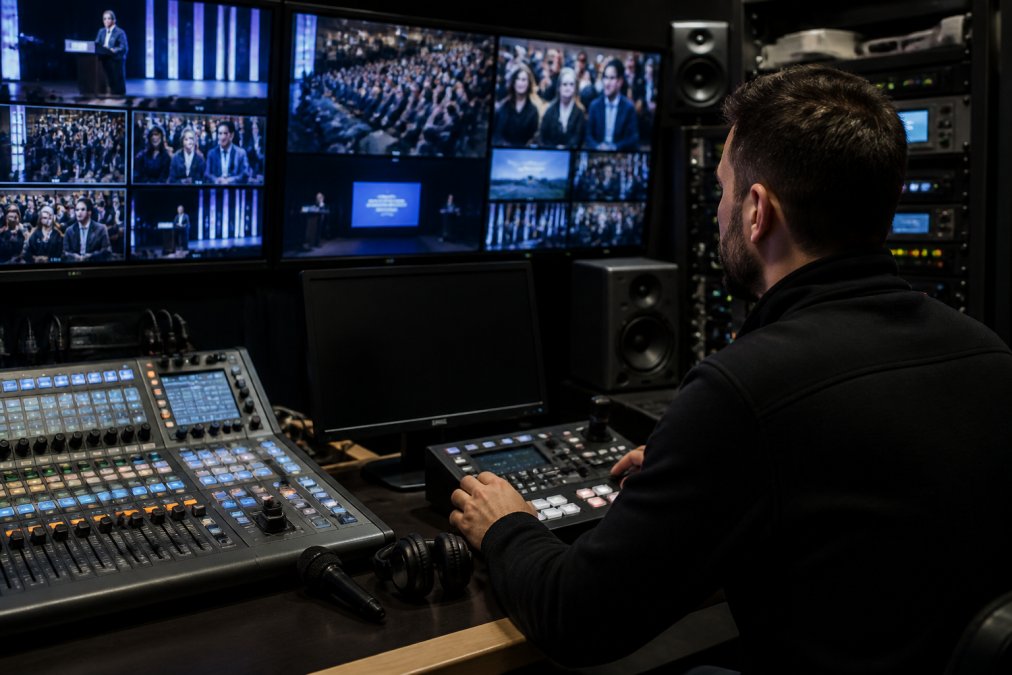
Multi-camera setups common in corporate events compound the security challenge. Each camera feed, graphics overlay, and audio track must be encrypted individually before being combined into the final broadcast stream. The platform should support encrypted ingest from multiple sources without requiring unencrypted intermediate storage.
Viewer Authentication and Access Control
Viewer authentication ensures only authorised people can access your broadcast. Single Sign-On (SSO) integration with your corporate directory, whether Microsoft Entra ID, Okta, or another identity provider, allows seamless access control without distributing separate credentials. When your CFO joins the earnings call, the platform verifies their identity against your corporate directory before granting stream access.
Data Residency and Content Ownership
Where your video is stored matters for compliance and control. Many cloud platforms default to multi-region storage across international data centres, problematic if your content contains sensitive Australian information subject to local data residency requirements. Ensure your platform offers data residency controls, storing recordings in Australian data centres if your compliance framework requires it.
Best Practices for Corporate Webcasting Security
Pre-Event Planning and Risk Assessment
Begin every broadcast with a security and operational risk assessment. Map your broadcast workflow: where is content originating, which systems touch it, where does it go, and who has access at each stage. A common mistake is assuming that once content leaves your facility and enters the platform, it’s the platform’s responsibility. In reality, you remain accountable for data that flows through your network.
Multi-Camera Setup and Failover Infrastructure
Corporate events often require multiple camera feeds, screen shares, and graphics. Each input point is a potential failure. Redundancy is essential: dual internet connections from different providers, backup cameras, and automated failover to secondary broadcast sources. When your main camera fails mid-presentation, the system should seamlessly switch to a backup without interrupting the stream.
Disaster Recovery and Contingency Procedures
A no-drop-off guarantee means the platform commits to maintaining stream continuity even during infrastructure failures. But you need to understand what that guarantee actually covers. Does it include your internet connection failing? Your broadcast source failing? The platform’s data centre going offline? Clarify the scope before you depend on it.
Live Streaming Data Security Standards and Compliance
Your broadcast must comply with relevant regulations governing data protection and privacy. In Australia, the Privacy Act 1988 and Australian Privacy Principles govern how you collect, store, and handle personal information, including viewer data and any personally identifiable information visible in your broadcast content.
Internal vs. External Communication Strategies
Internal communications, town halls, training sessions, board meetings, often contain sensitive information not intended for external audiences. External communications, product launches, investor relations events, public announcements, assume a broader audience but still require authentication and access controls.
Scalability, Bandwidth, and Ultra-Low Latency Delivery
Scalability determines whether your platform can handle your peak concurrent viewers without degradation. A 5,000-person event demands different infrastructure than a 50-person team meeting. The platform should auto-scale to meet demand, with no manual intervention required.
Post-Event Analytics and ROI Tracking
The value of your broadcast extends beyond the live event. Post-event analytics show who watched, for how long, and which segments captured the most attention. These insights inform future event strategy and justify the investment in live streaming infrastructure.
| Feature | Internal Events | External Events | Hybrid Events |
|---|---|---|---|
| Access Control | SSO + corporate directory | Registration + unique tokens | Tiered access by audience segment |
| Encryption | End-to-end required | HTTPS + encrypted delivery | Full encryption across all segments |
| Audience Size | 50-500 typical | 500-5,000+ typical | Mixed, requires scalability |
| Data Residency | Australian data centres preferred | Flexible, compliance-dependent | Australian storage if sensitive content |
| Latency Tolerance | 2-5 seconds acceptable | 2-3 seconds preferred for interactivity | Ultra-low latency for Q&A sessions |
Key Takeaways for Secure Corporate Broadcasting:
Secure live streaming for corporate communications requires encryption at multiple layers: encrypted ingest from broadcast sources, encrypted stream delivery to viewers, and encrypted storage of recordings. HTTPS alone is insufficient for sensitive corporate content.
A common mistake is treating platform security as independent from your network security. If your broadcast source connects to the internet through an unsecured corporate network, or if viewers access the stream from public WiFi, the platform’s encryption cannot protect content at those endpoints. Plan your entire broadcast workflow, not just the platform.
Test your disaster recovery procedures with a dry run before your live event. Many organisations discover their failover plan doesn’t work only when it matters most. A 30-minute test run can prevent a failed broadcast when thousands of people are watching.
External Sources for Further Reading:
Frequently Asked Questions
What makes a live streaming platform secure for corporate communications?
Secure live streaming platforms use end-to-end encryption to protect content during transmission, implement viewer authentication and access control to restrict who can watch, and provide data residency options so your content stays within your jurisdiction. They also use HTTPS connections, content delivery networks with security protocols, and audit trails to track who accessed the stream. Look for platforms offering SSO integration, real-time monitoring, and failover infrastructure to prevent interruptions during sensitive broadcasts.
How does secure live streaming differ from standard web conferencing tools?
Secure live streaming for corporate communications is designed for one-to-many broadcasts with strict access controls and compliance features, whereas web conferencing enables interactive two-way communication. Live streaming platforms prioritise broadcast quality, scalability for large audiences, encrypted stream delivery, and content ownership, critical for AGMs, product launches, and stakeholder communications. They also offer post-event analytics, recording management, and integration with corporate governance systems that standard conferencing tools lack.
What happens if your live stream drops during an important corporate event?
Professional secure live streaming services use multi-camera setups, redundant bandwidth connections, and failover infrastructure to prevent stream failures. If a primary connection fails, the system automatically switches to backup infrastructure without audience interruption. Disaster recovery protocols include pre-event testing, on-site technical support, and contingency streaming routes. Reputable providers offer no-drop-off guarantees backed by service level agreements, meaning you have recourse if failures occur. Always confirm your provider’s specific recovery procedures and support availability before your event.
Do you own the recordings from a secure live stream?
Yes, with professional secure live streaming services, you own all recordings by default. Your content belongs to you, not the platform provider. Recordings are typically delivered to you in high-definition format at no extra cost and can be reused for training, archival, or future stakeholder communications. Confirm that your service agreement explicitly grants you perpetual ownership and provides unrestricted access to download and redistribute recordings internally. This is essential for compliance documentation and internal knowledge management.
Can secure live streaming work reliably in regional areas with variable internet quality?
Yes, professional platforms use content delivery networks and adaptive bitrate streaming to maintain broadcast quality even with fluctuating bandwidth. The stream automatically adjusts resolution and frame rate to match available connection speed, ensuring viewers see HD quality on devices that support it without buffering. For critical regional events, use redundant internet connections (dual carriers) and pre-test your venue’s network conditions. Professional managed services handle this planning for you, monitoring bandwidth in real time and switching routes if primary connections degrade.
What compliance requirements apply to secure corporate live streaming?
Compliance depends on your content type and audience. Internal communications must comply with workplace privacy laws and data protection standards. If you stream to external stakeholders, you may need to meet privacy regulations and accessibility standards. Sensitive financial communications (like AGMs) may require audit trails and access logging. Always confirm your platform provider uses encrypted stream delivery, maintains audit logs, complies with relevant data protection frameworks, and can provide compliance documentation. Consult your legal team about specific requirements for your event type.
How many concurrent viewers can enterprise live streaming platforms handle?
Professional enterprise platforms scale to handle thousands of concurrent viewers, many support 5,000+ simultaneous streams without quality degradation. Scalability depends on your platform’s content delivery network infrastructure and bandwidth allocation. Before committing, confirm your provider can support your expected audience size and has tested that capacity. Most professional services will conduct load testing before your event to ensure ultra-low latency delivery and consistent broadcast quality, regardless of viewer count.