7 Benefits of Hybrid Events for Adelaide Businesses
Last Updated: November 12, 2026
Quick Summary
Hybrid events give Adelaide businesses reach beyond geographic boundaries, stronger attendance and engagement across time zones, and cost and resource efficiencies without losing impact. One production crew serves both audiences, and the recording becomes reusable content that extends the value of the original spend.
- Hybrid events combine an in-person audience with a live stream and interactive virtual platform.
- Recorded, on-demand access captures remote attendees in different time zones who miss the live session.
- A hybrid format typically reduces venue, catering and travel spend while increasing production and platform costs.
- Test venue connectivity under load during a rehearsal, not on the morning of the event.
- Define measurable outcomes and choose your format 6-8 weeks out, with a full technical rehearsal one week before.
Table of Contents
- Why Adelaide Businesses Are Moving to Hybrid Events
- Benefit 1: Audience Reach Beyond Geographic Boundaries
- Benefit 2: Stronger Attendance and Engagement Across Time Zones
- Benefit 3: Cost and Resource Efficiencies Without Losing Impact
- Hybrid Event Engagement Ideas That Keep Online Attendees Involved
- Hybrid Event Technology and Live Streaming for Corporate Events
- Hybrid Event Planning: A Practical Step-by-Step Approach
- Book a Hybrid Event Production Quote
- Frequently Asked Questions
Why Adelaide Businesses Are Moving to Hybrid Events
Hybrid events combine an in-person audience with a live stream and interactive virtual platform, so people can attend from anywhere without missing the room. The benefits of hybrid events for Adelaide businesses come down to reach, resilience and cost control. A single event can serve a boardroom in the city and a stakeholder in another state at the same time. Below, we break down seven benefits, plus the planning and technology decisions that make them real.
The shift isn’t driven by novelty. It’s driven by a simple calculation. Travel is expensive, calendars are tight, and a purely physical event caps your audience at the venue’s capacity. Hybrid removes that ceiling, but only when the production is handled properly. That’s the part most guides skip.
Benefit 1: Audience Reach Beyond Geographic Boundaries
Geographic boundaries stop mattering when the stream is reliable. A hybrid event format lets an Adelaide business invite interstate clients, regional staff and overseas partners without asking anyone to book a flight. Audience reach expands the moment the virtual platform goes live.
For local firms, this matters most with distributed workforces. A town hall that once served one office can now reach every branch. The same applies to conferences and product launches, where a broader audience means more qualified leads and better attendance.
The catch is connectivity. Remote attendees judge your event by their own connection, so the stream has to hold up across devices and locations.
Benefit 2: Stronger Attendance and Engagement Across Time Zones
Time zones are the quiet killer of attendance. A hybrid event can be recorded and offered on-demand, so remote attendees in different time zones watch when it suits them. Live participation still works for the majority, and recorded access captures the rest.
Engagement doesn’t have to drop just because people are remote. Live polling, questionnaires and moderated Q&A give online participants a direct line into the room.
Attendance data tells the story. Registration, live viewing and on-demand replays give event organisers measurable outcomes that a physical-only event simply can’t produce.
Benefit 3: Cost and Resource Efficiencies Without Losing Impact
Cost efficiencies in a hybrid event come from shifting spend rather than simply cutting it. The main categories to compare are venue capacity, catering, travel and accommodation, production and streaming, and platform or registration fees. A hybrid format typically reduces the first three and increases the last two, so the net effect depends on how many remote attendees you expect.
The resource efficiency is easier to see. One production crew serves both audiences, one run sheet governs the day, and the recording becomes reusable content afterward. That recording can feed training libraries, sales enablement and on-demand access, which extends the value of the original spend well beyond the live session.
Assessing ROI means measuring more than attendance. Track registration and live viewing, engagement through polling and Q&A participation, lead generation where the event is commercial, and post-event conversions such as demo requests or follow-up meetings. Compare those against the cost categories above to see whether the hybrid format is paying for itself.
That doesn’t mean hybrid is free. It means the spend shifts from logistics to production quality. For a sense of how that investment is structured, our professional live streaming service pricing guide sets out the variables that affect cost.
Watch out: cutting production budget to fund a bigger venue is the classic false economy here. A glitchy stream costs more in credibility than a smaller room ever would.
Hybrid Event Engagement Ideas That Keep Online Attendees Involved
The biggest mistake with hybrid event engagement ideas is treating the virtual audience as passive viewers. They should be participants with their own channel into the event.
Here’s what works:
- Live polling after each major segment, with results shown in the room
- Moderated Q&A that gives online questions equal billing
- Chat prompts tied to the agenda, not left to chance
- Short on-camera check-ins with remote attendees
- On-demand access to sessions so nobody misses a track
For a deeper set of tactics, our guide on how to increase virtual attendee participation walks through the step-by-step approach we use on client events.
Hybrid Event Technology and Live Streaming for Corporate Events
Hybrid event technology lives or dies on three things: venue connectivity, audiovisual redundancy, and on-site technical support. Venue internet is often a key constraint, so it should be tested before anything else is booked.
Start with a connectivity audit. Ask the venue for a dedicated wired connection rather than shared Wi-Fi, and confirm the upload speed available on the day, not just the headline plan. Test any connection under load during a rehearsal, not on the morning of the event.
Audiovisual equipment benefits from redundancy at critical points, so that a single failure does not reach the audience. HD quality across all devices is the baseline remote attendees expect, and it depends more on stable upload bandwidth and sensible encoding settings than on camera spend.
For sensitive internal communications, ask any provider how access to the stream is controlled before you sign.
For a deeper set of tactics, our guide on how to increase virtual attendee participation walks through the step-by-step approach we use on client events. Our end-to-end live streaming solutions guide covers how the components fit together, and our notes on no-glitch streaming explain the technical practices that keep viewers engaged.
Watch out: relying on a venue’s Wi-Fi claim alone can put a hybrid stream at risk.
Hybrid Event Planning: A Practical Step-by-Step Approach
Hybrid event planning is the discipline of running two audiences as one event. Get the sequence right and the rest follows.
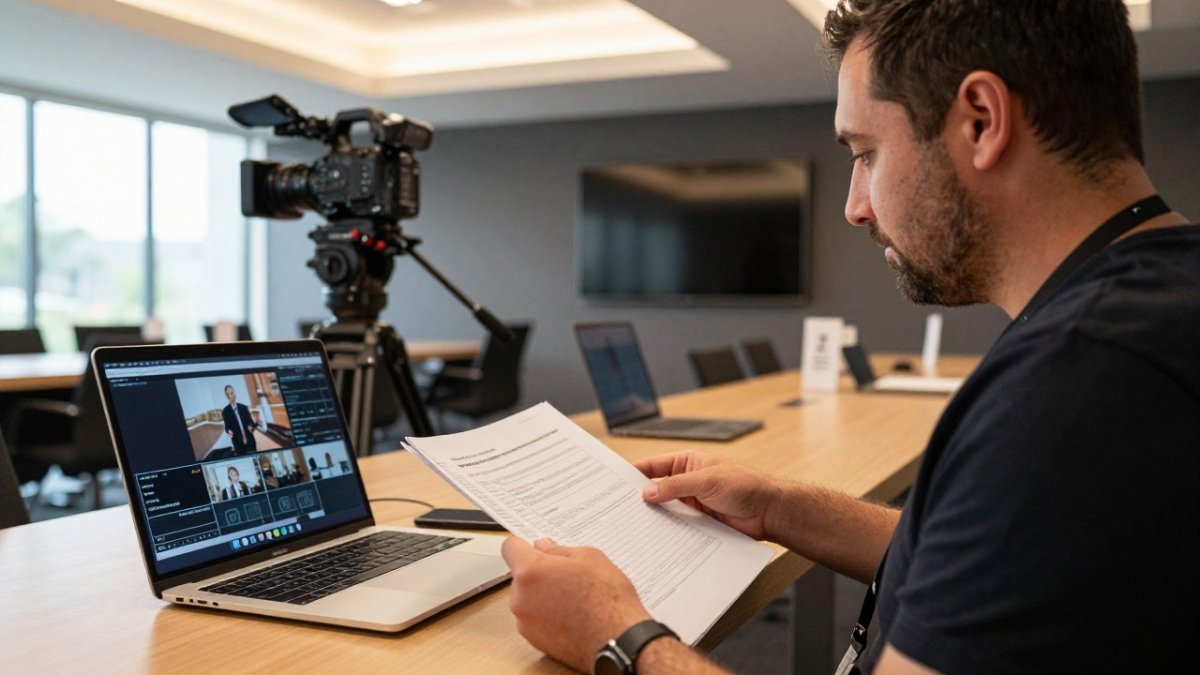
- Define the outcome. Decide what measurable outcomes matter: attendance, engagement metrics, audience feedback.
- Choose the format. Full hybrid, virtual-first with a physical hub, or in-person with a stream. Each has trade-offs.
- Map the venue. Venue layout, capacity and internet connectivity decide what’s technically possible.
- Lock the hardware. Cameras, audio and encoding gear need to be specified early. Our guide to live streaming hardware for corporate events covers the essentials.
- Rehearse. A full technical run-through catches the problems a live audience never forgives.
- Run and record. Capture everything, then repurpose it.
- Follow up. Send recordings, feedback surveys and highlights within days.
| Step | Typical Lead Time | Owner |
|---|---|---|
| Define outcomes and format | 6-8 weeks out | Event organiser |
| Venue and connectivity check | 4-6 weeks out | Production partner |
| Hardware and stream setup | 2-3 weeks out | AV and streaming team |
| Full technical rehearsal | 1 week out | Everyone |
| Live event and recording | Event day | Production crew |
| Follow-up and on-demand delivery | Within 1 week after | Marketing team |
Accessibility deserves a line of its own. Risks are manageable too: have a backup connection, a recorded fallback, and a named person responsible for the stream.
Book a Hybrid Event Production Quote
The challenge is simple: hybrid events only deliver their benefits when the production holds up under pressure. A dropped stream or poor mobile playback undoes the reach and cost gains in minutes.
That’s where we come in. Webcasting Livestream provides managed, end-to-end production with a no drop-off guarantee, fail-safe procedures, and full recordings supplied at no extra cost. Your content belongs to you, and HD quality is delivered across all devices.
Get started with Webcasting Livestream and run a hybrid event your online audience actually stays for.
Ready to plan your next hybrid event? Tell us your date and audience size, and we’ll map the production.
Frequently Asked Questions
What are the main benefits of hosting a hybrid event?
Hybrid events combine in-person attendance with virtual attendance, so you reach people who cannot travel while still giving local guests the in-person experience. The main benefits are broader audience reach beyond geographic boundaries, lower travel and catering costs, more flexible scheduling across time zones, and richer engagement data. You also get a recording you can reuse for training or on-demand access, which extends the value of a single event.
How can businesses keep online attendees engaged during a hybrid event?
Treat remote attendees as a real audience, not a passive stream. Run live polling and questionnaires throughout, have a dedicated host reading and responding to online questions, and give virtual viewers their own Q&A moments. Short segments, clear on-screen graphics and a visible countdown all help. Pairing hybrid event engagement ideas like these with reliable streaming means online participants stay involved rather than drifting away.
What technology is needed to run a successful hybrid event?
You need a stable internet connection at the venue, professional audiovisual equipment, encoding and streaming software, and a virtual platform that supports live participation and on-demand access. AV reliability matters most: a dropped stream undoes the goodwill the event built. Many organisers bring in a managed provider for hybrid event technology so fail-safe procedures, technical support and HD delivery across devices are handled end to end.
Are hybrid events more cost-effective than in-person events?
Often yes, because you reduce travel costs, catering costs and venue capacity pressure while reaching more people. The savings are not automatic, though. Budget for streaming production, AV and platform costs alongside the venue, and weigh them against the extra registrations and the reusable recording you gain. A simple comparison of total cost against measurable outcomes, such as attendance and engagement metrics, shows whether a hybrid format pays off for your event.